


The QProcess class is used to start external commands. More...
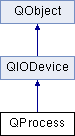
Public Types | |
| enum | ExitStatus |
| enum | InputChannelMode |
| enum | ProcessChannel |
| enum | ProcessChannelMode |
| enum | ProcessError |
| enum | ProcessState |
 Public Types inherited from QIODevice Public Types inherited from QIODevice | |
| enum | OpenModeFlag |
Public Signals | |
| void | errorOccurred (QProcess::ProcessError error) |
| void | finished (int exitCode) |
| void | finished (int exitCode, QProcess::ExitStatus exitStatus) |
| void | readyReadStandardError () |
| void | readyReadStandardOutput () |
| void | started () |
| void | stateChanged (QProcess::ProcessState newState) |
| Public Signals inherited from QIODevice | |
| void | aboutToClose () |
| void | bytesWritten (qint64 bytes) |
| void | readChannelFinished () |
| void | readyRead () |
| Public Signals inherited from QObject | |
| void | destroyed (QObject *obj=nullptr) |
| void | objectNameChanged (const QString &objectName) |
Public Slots | |
| void | kill () |
| void | terminate () |
| Public Slots inherited from QObject | |
| void | deleteLater () |
Public Methods | |
| QProcess (QObject *parent=nullptr) | |
| virtual | ~QProcess () |
| QStringList | arguments () const |
| bool | atEnd () const override |
| qint64 | bytesAvailable () const override |
| qint64 | bytesToWrite () const override |
| bool | canReadLine () const override |
| void | close () override |
| void | closeReadChannel (ProcessChannel channel) |
| void | closeWriteChannel () |
| QStringList | environment () const |
| QProcess::ProcessError | error () const |
| int | exitCode () const |
| QProcess::ExitStatus | exitStatus () const |
| InputChannelMode | inputChannelMode () const |
| bool | isSequential () const override |
| QString | nativeArguments () const |
| bool | open (OpenMode mode=ReadWrite) override |
| Q_PID | pid () const |
| ProcessChannelMode | processChannelMode () const |
| QProcessEnvironment | processEnvironment () const |
| qint64 | processId () const |
| QString | program () const |
| QByteArray | readAllStandardError () |
| QByteArray | readAllStandardOutput () |
| ProcessChannel | readChannel () const |
| ProcessChannelMode | readChannelMode () const |
| void | setArguments (const QStringList &arguments) |
| void | setEnvironment (const QStringList &environment) |
| void | setInputChannelMode (InputChannelMode mode) |
| void | setNativeArguments (const QString &arguments) |
| void | setProcessChannelMode (ProcessChannelMode mode) |
| void | setProcessEnvironment (const QProcessEnvironment &environment) |
| void | setProgram (const QString &command) |
| void | setReadChannel (ProcessChannel channel) |
| void | setReadChannelMode (ProcessChannelMode mode) |
| void | setStandardErrorFile (const QString &fileName, OpenMode mode=Truncate) |
| void | setStandardInputFile (const QString &fileName) |
| void | setStandardOutputFile (const QString &fileName, OpenMode mode=Truncate) |
| void | setStandardOutputProcess (QProcess *destination) |
| void | setWorkingDirectory (const QString &dir) |
| void | start (const QString &command, const QStringList &arguments, OpenMode mode=ReadWrite) |
| void | start (const QString &command, OpenMode mode=ReadWrite) |
| void | start (OpenMode mode=ReadWrite) |
| QProcess::ProcessState | state () const |
| bool | waitForBytesWritten (int msecs=30000) override |
| bool | waitForFinished (int msecs=30000) |
| bool | waitForReadyRead (int msecs=30000) override |
| bool | waitForStarted (int msecs=30000) |
| QString | workingDirectory () const |
| Public Methods inherited from QIODevice | |
| QIODevice () | |
| QIODevice (QObject *parent) | |
| virtual | ~QIODevice () |
| QString | errorString () const |
| bool | getChar (char *c) |
| bool | isOpen () const |
| bool | isReadable () const |
| bool | isTextModeEnabled () const |
| bool | isWritable () const |
| OpenMode | openMode () const |
| qint64 | peek (char *data, qint64 maxSize) |
| QByteArray | peek (qint64 maxSize) |
| virtual qint64 | pos () const |
| bool | putChar (char c) |
| qint64 | read (char *data, qint64 maxSize) |
| QByteArray | read (qint64 maxSize) |
| QByteArray | readAll () |
| qint64 | readLine (char *data, qint64 maxSize) |
| QByteArray | readLine (qint64 maxSize=0) |
| virtual bool | reset () |
| virtual bool | seek (qint64 pos) |
| void | setTextModeEnabled (bool enabled) |
| virtual qint64 | size () const |
| void | ungetChar (char c) |
| qint64 | write (const char *data) |
| qint64 | write (const char *data, qint64 maxSize) |
| qint64 | write (const QByteArray &data) |
| Public Methods inherited from QObject | |
| QObject (QObject *parent=nullptr) | |
| ~QObject () | |
| bool | blockSignals (bool block) |
| const QList< QObject * > & | children () const |
| bool | connect (const QObject *sender, const QString &signalMethod, const QString &location, const QString &slotMethod, Qt::ConnectionType type=Qt::AutoConnection) |
| bool | connect (const QObject *sender, const QString &signalMethod, const QString &slotMethod, Qt::ConnectionType type=Qt::AutoConnection) |
| bool | disconnect (const QObject *receiver, const QString &slotMethod=QString ()) const |
| bool | disconnect (const QString &signalMethod, const QString &location, const QObject *receiver=nullptr, const QString &slotMethod=QString ()) const |
| bool | disconnect (const QString &signalMethod=QString (), const QObject *receiver=nullptr, const QString &slotMethod=QString ()) const |
| void | dumpObjectInfo () |
| void | dumpObjectTree () |
| QList< QString > | dynamicPropertyNames () const |
| virtual bool | event (QEvent *event) |
| virtual bool | eventFilter (QObject *watched, QEvent *event) |
| template<typename T > | |
| T | findChild (const QString &childName=QString ()) const |
| template<class T > | |
| QList< T > | findChildren (const QRegularExpression ®Exp, Qt::FindChildOptions options=Qt::FindChildrenRecursively) const |
| template<class T > | |
| QList< T > | findChildren (const QString &childName=QString (), Qt::FindChildOptions options=Qt::FindChildrenRecursively) const |
| bool | inherits (const QString &className) const |
| void | installEventFilter (QObject *filterObj) |
| bool | isWidgetType () const |
| bool | isWindowType () const |
| void | killTimer (int id) |
| const QMetaObject * | metaObject () const |
| void | moveToThread (QThread *targetThread) |
| QString | objectName () const |
| QObject * | parent () const |
| template<class T = QVariant> | |
| T | property (const QString &name) const |
| void | removeEventFilter (QObject *obj) |
| void | setObjectName (const QString &name) |
| void | setParent (QObject *parent) |
| bool | setProperty (const QString &name, const QVariant &value) |
| bool | signalsBlocked () const |
| int | startTimer (int interval, Qt::TimerType timerType=Qt::CoarseTimer) |
| QThread * | thread () const |
Static Public Methods | |
| static int | execute (const QString &command) |
| static int | execute (const QString &command, const QStringList &arguments) |
| static QString | nullDevice () |
| static bool | startDetached (const QString &command) |
| static bool | startDetached (const QString &command, const QStringList &arguments, const QString &workingDirectory=QString (), qint64 *pid=nullptr) |
| static QStringList | systemEnvironment () |
| Static Public Methods inherited from QObject | |
| static bool | connect (const QObject *sender, const QMetaMethod &signalMethod, const QObject *receiver, const QMetaMethod &slotMethod, Qt::ConnectionType type=Qt::AutoConnection) |
| static bool | connect (const QObject *sender, const QString &signalMethod, const QObject *receiver, const QString &slotMethod, Qt::ConnectionType type=Qt::AutoConnection, const QString &location=QString ()) |
| static bool | connect (const QObject *sender, const QString &signalMethod, const QString &location, const QObject *receiver, const QString &slotMethod, Qt::ConnectionType type=Qt::AutoConnection) |
| template<class Sender , class SignalClass , class... SignalArgs, class Receiver , class SlotClass , class... SlotArgs, class SlotReturn > | |
| static bool | connect (const Sender *sender, void (SignalClass::*signalMethod)(SignalArgs...), const Receiver *receiver, SlotReturn (SlotClass::*slotMethod)(SlotArgs...), Qt::ConnectionType type=Qt::AutoConnection) |
| template<class Sender , class SignalClass , class... SignalArgs, class Receiver , class T > | |
| static bool | connect (const Sender *sender, void (SignalClass::*signalMethod)(SignalArgs...), const Receiver *receiver, T slotLambda, Qt::ConnectionType type=Qt::AutoConnection) |
| static bool | disconnect (const QObject *sender, const QMetaMethod &signalMethod, const QObject *receiver, const QMetaMethod &slotMethod) |
| static bool | disconnect (const QObject *sender, const QString &signalMethod, const QObject *receiver, const QString &slotMethod) |
| static bool | disconnect (const QObject *sender, const QString &signalMethod, const QString &location, const QObject *receiver, const QString &slotMethod) |
| static bool | disconnect (const QObject *sender, std::nullptr_t, const QObject *receiver, std::nullptr_t) |
| template<class Sender , class SignalClass , class... SignalArgs, class Receiver , class SlotClass , class... SlotArgs, class SlotReturn > | |
| static bool | disconnect (const Sender *sender, void (SignalClass::*signalMethod)(SignalArgs...), const Receiver *receiver, SlotReturn (SlotClass::*slotMethod)(SlotArgs...)) |
| template<class Sender , class SignalClass , class... SignalArgs, class Receiver > | |
| static bool | disconnect (const Sender *sender, void (SignalClass::*signalMethod)(SignalArgs...), const Receiver *receiver, std::nullptr_t slotMethod=nullptr) |
| template<class Sender , class SignalClass , class... SignalArgs, class Receiver , class T > | |
| static bool | disconnect (const Sender *sender, void (SignalClass::*signalMethod)(SignalArgs...), const Receiver *receiver, T slotMethod) |
| static QMetaObject & | staticMetaObject () |
| static QString | tr (const char *text, const char *comment=nullptr, std::optional< int > numArg=std::optional< int >()) |
Protected Methods | |
| qint64 | readData (char *data, qint64 maxlen) override |
| void | setProcessState (ProcessState state) |
| virtual void | setupChildProcess () |
| qint64 | writeData (const char *data, qint64 len) override |
| Protected Methods inherited from QIODevice | |
| virtual qint64 | readLineData (char *data, qint64 maxSize) |
| void | setErrorString (const QString &errorString) |
| void | setOpenMode (OpenMode openMode) |
| Protected Methods inherited from QObject | |
| virtual void | childEvent (QChildEvent *event) |
| virtual void | connectNotify (const QMetaMethod &signalMethod) const |
| virtual void | customEvent (QEvent *event) |
| virtual void | disconnectNotify (const QMetaMethod &signalMethod) const |
| bool | isSignalConnected (const QMetaMethod &signalMethod) const |
| int | receivers (const QString &signal) const |
| QObject * | sender () const |
| int | senderSignalIndex () const |
| virtual void | timerEvent (QTimerEvent *event) |
Related Functions | |
These are not member functions | |
| typedef | Q_PID |
| Related Functions inherited from QObject | |
| T | qobject_cast (QObject *object) |
| QObjectList | |
Additional Inherited Members | |
| Public Typedefs inherited from QIODevice | |
| using | OpenMode = QFlags< OpenModeFlag > |
| Properties inherited from QObject | |
| objectName | |
Detailed Description
The QProcess class is used to start an external command by launching a separate task in the operating system. This class is an interface to the operating system task management functions. On Unix and Mac OS X these task functions are fork() and exec(). On Windows the OS function CreateProcess() is called.
As an example, on Unix and Mac OS X calling QProcess::start() is responsible for interfacing with the OS.
- creates a new task by calling fork()
- calls exec() to run a command like ls or touch
Running a Command
To run a command pass the program name and any required arguments which are necessary. Arguments are supplied as individual strings in a QStringList. The following code runs "someUtility" and passes –version and –help as two arguments.
QProcess::start() sets the enum ProcessState to the value Starting. When the command is started myProcess enters the Running state and emits the started() signal.
When the command exits QProcess returns to the NotRunning state and emits the finished() signal. This signal provides the exit code and status of the command. Call exitCode() or exitStatus() for information about the last command. If an error occurs the error() signal is emitted. Call error() or state() to retrieve additional information.
Reading and Writing
This class allows reading and writing from a command as a sequential I/O device. To write to and read from the command call methods inherited from QIODevice like read(), write(), readLine(), and getChar().
Communicating via Channels
QProcess has two predefined output channels.
- standard output channel (
stdout) contains regular console output - standard error channel (
stderr) contains the errors printed by the command
These channels represent two separate streams of data. You can toggle between them by calling setReadChannel(). QProcess emits readyRead() when data is available on the current read channel. It also emits readyReadStandardOutput() when new standard output data is available, and when new standard error data is available, readyReadStandardError() is emitted. Instead of calling read(), readLine(), or getChar(), you can explicitly read all data from either of the two channels by calling readAllStandardOutput() or readAllStandardError().
The terminology for the channels can be misleading. The stdout channel corresponds to the QProcess read channel. The stdin channel corresponds to the QProcess write channels.
QProcess can merge the two output channels so standard output and standard error data from the running command both use the standard output channel. Call setProcessChannelMode() with MergedChannels before starting the command to activate this feature. You also have the option of forwarding the output of the running command to the calling, main command, by passing ForwardedChannels as the argument.
Certain commands need a special environment variabal to be set in order to work correctly. Environment variables can be set by calling setEnvironment(). To set a working directory call setWorkingDirectory(). By default, commands are run in the current working directory of the CopperSpice application.
Synchronous API
QProcess provides a set of methods which allow this class to be used without an event loop. This is done by suspending the calling thread until certain signals are emitted. Calling these from the main QApplication thread may cause the user interface to freeze.
- waitForStarted()
- blocks until the command has started
- waitForReadyRead()
- blocks until new data is available for reading on the current read channel
- waitForBytesWritten()
- blocks until one payload of data has been written to the command
- waitForFinished()
- blocks until the command has finished
The following example runs gzip to compress the string "CopperSpice is wonderful" without an event loop.
Windows OS
Some Windows commands like dir are not implemented as a separate executable and therefore can not be started by QProcess. A better solution is to execute the command interpreter and ask the interpreter to execute the command.
Member Enumeration Documentation
| enum QProcess::ExitStatus |
This enum describes the exit status of a QProcess.
| Constant | Value | Description |
|---|---|---|
QProcess::NormalExit | 0 | Exited normally |
QProcess::CrashExit | 1 | Crashed |
- See also
- exitStatus()
This enum describes the input channel modes of QProcess. Pass one of these values to setInputChannelMode() to set the current write channel mode.
| Constant | Value | Description |
|---|---|---|
QProcess::ManagedInputChannel | 0 | QProcess manages the input of the running task. Default input channel mode of QProcess. |
QProcess::ForwardedInputChannel | 1 | QProcess forwards the input of the CopperSpice application to the running command. The CopperSpice application must not read from standard input while the command is running. |
- See also
- setInputChannelMode()
This enum describes the channels used by the running task. Pass one of these values to setReadChannel() to set the current read channel of QProcess.
| Constant | Value | Description |
|---|---|---|
QProcess::StandardOutput | 0 | Standard output (stdout) of the running command |
QProcess::StandardError | 1 | Standard error (stderr) of the running command |
- See also
- setReadChannel()
This enum describes the channel modes of QProcess. Pass one of these values to setProcessChannelMode() to set the current read channel mode.
| Constant | Value | Description |
|---|---|---|
QProcess::SeparateChannels | 0 | QProcess manages the output of the running command, keeping standard output and standard error data in separate internal buffers. Select the QProcess current read channel by calling setReadChannel(). Default channel mode of QProcess. |
QProcess::MergedChannels | 1 | QProcess merges the output of the running command into the standard output channel (stdout). The standard error channel (stderr) will not receive any data. The standard output and standard error of the running command are interleaved. |
QProcess::ForwardedChannels | 2 | QProcess forwards the output of the running command to the CopperSpice application. Anything the command writes to standard output and standard error will be written to the standard output and standard error of the CopperSpice application. |
- See also
- setProcessChannelMode()
This enum describes the different types of errors which are reported by QProcess.
| Constant | Value | Description |
|---|---|---|
QProcess::FailedToStart | 0 | Task failed to start. Either the invoked command is missing, or you may have insufficient permissions to invoke the command. |
QProcess::Crashed | 1 | Task crashed some time after starting successfully. |
QProcess::Timedout | 2 | Last waitFor...() function timed out. The state of QProcess is unchanged, and you can try calling waitFor...() again. |
QProcess::WriteError | 4 | An error occurred when attempting to write to the command. For example, the command may not be running, or it may have closed its input channel. |
QProcess::ReadError | 3 | An error occurred when attempting to read from the command. For example, the command may not be running. |
QProcess::UnknownError | 5 | An unknown error occurred. This is the default return value of error(). |
- See also
- error()
This enum describes the different states of QProcess.
| Constant | Value | Description |
|---|---|---|
QProcess::NotRunning | 0 | Process is not running. |
QProcess::Starting | 1 | Process is starting, but the command has not yet been invoked. |
QProcess::Running | 2 | Process is running and is ready for reading and writing. |
- See also
- state()
Constructor & Destructor Documentation
|
explicit |
Constructs a new QProcess with the given parent.
|
virtual |
Destroys this QProcess. This method will not return until the task is terminated.
Method Documentation
| QStringList QProcess::arguments | ( | ) | const |
Returns the command line arguments this QProcess was last started with.
- See also
- setArguments(), start()
|
overridevirtual |
Returns true if this QProcess is not running and no more data is available for reading, otherwise returns false.
Reimplemented from QIODevice::atEnd()
|
overridevirtual |
Reimplemented from QIODevice::bytesAvailable()
|
overridevirtual |
Reimplemented from QIODevice::bytesToWrite()
|
overridevirtual |
This method operates on the current read channel.
- See also
- readChannel(), setReadChannel()
Reimplemented from QIODevice::canReadLine()
|
overridevirtual |
Closes all communication with the last command started by this QProcess and kills the running task. After calling this method QProcess will no longer emit readyRead() and data can no longer be read or written.
Reimplemented from QIODevice::close()
| void QProcess::closeReadChannel | ( | ProcessChannel | channel | ) |
Closes the read channel. After calling this method QProcess will no longer receive data on the channel. Any data which has already been received is still available for reading. Call this method to save memory, if you are not interested in the output of the command.
- See also
- closeWriteChannel(), setReadChannel()
| void QProcess::closeWriteChannel | ( | ) |
Schedules the write channel of QProcess to be closed. The channel will close once all data has been written to the command. After calling this method any attempts to write to the command will fail.
Closing the write channel is necessary for commands which read input data until the channel has been closed. For example, the "more" command is used to display text data in a console on both Unix and Windows. It will not display any text data until the write channel for myProcess has been closed.
The write channel is implicitly opened when start() is called.
- See also
- closeReadChannel()
| QStringList QProcess::environment | ( | ) | const |
Returns the environment which QProcess will use when starting a command, or an empty QStringList if no environment has been set using setEnvironment() or setEnvironmentHash(). If no environment has been set, the environment of the calling command will be used.
| QProcess::ProcessError QProcess::error | ( | ) | const |
Returns the type of error which occurred last.
- See also
- state()
|
signal |
This signal is emitted when an error occurs with the command. The specified error describes the type of error which occurred.
|
static |
Starts command in a new task. The value for command is a single string of text containing both the program name and any required arguments which are separated by one or more spaces.
|
static |
Starts command with the passed arguments in a new task. This method then waits for the command to finish and returns the exit code of the command. Any data the new command writes to the console is captured by QProcess. The environment and working directory are inherited from the calling command.
If the command can not be started -2 is returned. If the command crashes -1 is returned. Otherwise, the exit code is returned.
On Windows, arguments which contain spaces must be wrapped in quotes.
| int QProcess::exitCode | ( | ) | const |
Returns the exit code of the last command which finished.
| QProcess::ExitStatus QProcess::exitStatus | ( | ) | const |
Returns the exit status of the last command which finished.
On Windows, if the task was terminated with TerminateProcess() from another application this method will still return NormalExit unless the exit code is less than 0.
|
signal |
This signal is emitted when the command finishes. The parameter exitCode is the exit code of the command and exitStatus is the exit status for the task. After the commands has finished, the buffers in QProcess are still intact. This means you can still read any data which the command may have written before it finished.
Since the finished() signal is overloaded. Use the following syntax to connect this signal to some slot, which in this example is a lambda expression.
|
signal |
This signal is emitted when the command finishes. The exitCode is the exit code of the command and exitStatus is the exit status of the task. The slot can read any data the comman may have written before it finished.
- See also
- exitStatus()
| InputChannelMode QProcess::inputChannelMode | ( | ) | const |
Returns the channel mode of the QProcess standard input channel.
- See also
- setInputChannelMode(), InputChannelMode
|
overridevirtual |
Reimplemented from QIODevice::isSequential()
|
slot |
Kills the current task causing it to exit immediately. On Unix and Mac OS X the SIGKILL signal is sent to the task. On Windows kill() uses TerminateProcess().
| QString QProcess::nativeArguments | ( | ) | const |
Returns the additional native command line arguments. This method is only available on Windows.
- See also
- setNativeArguments()
|
static |
The null device of the operating system. The returned file path uses native directory separators.
|
overridevirtual |
Opens the device and sets its OpenMode to mode. Returns true if successful, otherwise returns false. This method should be called from any existing reimplementation of open() or other functions that open the device.
- See also
- openMode(), OpenMode
Reimplemented from QIODevice::open()
| Q_PID QProcess::pid | ( | ) | const |
Returns the native task identifier for the running command, if available. If no command is currently running then a value of 0 is returned.
| ProcessChannelMode QProcess::processChannelMode | ( | ) | const |
Returns the channel mode of the QProcess standard output and standard error channels.
| QProcessEnvironment QProcess::processEnvironment | ( | ) | const |
Returns a list of environment variables QProcess will use when starting a command. An empty list is returned if no environment variables were set by calling setEnvironment() or setProcessEnvironment(). In this case, the environment variables are inherited from your system environment.
| qint64 QProcess::processId | ( | ) | const |
Returns the native task identifier for the running command, if available. If no command is currently running, 0 is returned.
| QString QProcess::program | ( | ) | const |
Returns the name of the command most recently started by this QProcess.
- See also
- setProgram(), start()
| QByteArray QProcess::readAllStandardError | ( | ) |
Regardless of the current read channel, this method returns all data available from the standard error of the command as a QByteArray.
| QByteArray QProcess::readAllStandardOutput | ( | ) |
Regardless of the current read channel, this method returns all data available from the standard output of the command as a QByteArray.
| ProcessChannel QProcess::readChannel | ( | ) | const |
Returns the current read channel of the QProcess.
- See also
- setReadChannel()
|
deprecated |
- Deprecated:
- Returns the read channel mode of the QProcess. Equivalent to calling to processChannelMode().
- See also
- setReadChannelMode(), processChannelMode()
Implements QIODevice::readData()
|
signal |
This signal is emitted when the command has made new data available through its standard error channel (stderr). It is emitted regardless of the current read channel.
- See also
- readAllStandardError(), readChannel()
|
signal |
This signal is emitted when the command has made new data available through its standard output channel (stdout). It is emitted regardless of the current read channel.
- See also
- readAllStandardOutput(), readChannel()
| void QProcess::setArguments | ( | const QStringList & | arguments | ) |
Sets the arguments to use when starting the command. This method must be called before calling start().
This method takes a list of strings and automatically handles quoting the arguments which contain spaces to ensure they are passed correctly across different operating systems.
On Windows, the arguments are quoted to be compatible with the CommandLineToArgvW() Windows function. For more information refer to the documentation for setNativeArguments().
- See also
- arguments(), setProgram(), start()
| void QProcess::setEnvironment | ( | const QStringList & | environment | ) |
Sets one or more environment variables which QProcess will use when starting a command. Each element of the given environment must contain a key and a value, separated by an equal sign.
For example, the following codes add the C:\BIN directory to the list of executable paths (PATHS) on Windows and sets TMPDIR:
| void QProcess::setInputChannelMode | ( | InputChannelMode | mode | ) |
Sets the channel mode of the QProcess standard input channel to the mode specified. This mode will be used the next time start() is called.
- See also
- inputChannelMode(), InputChannelMode
| void QProcess::setNativeArguments | ( | const QString & | arguments | ) |
Sets additional native command line arguments. This method is only available on Windows.
This method is necessary when setArguments() can not handle complex or non-standard argument parsing for certain programs. One notable program which does not follow the Windows CommandLineToArgvW() syntax is cmd.exe and therefore all batch scripts.
The value of arguments is a single raw string which is appended to the command program name and any other arguments previously passed.
- See also
- nativeArguments(), setArguments()
| void QProcess::setProcessChannelMode | ( | ProcessChannelMode | mode | ) |
Sets the channel mode of the QProcess standard output and standard error channels to mode. The new mode will be used the next time start() is called.
| void QProcess::setProcessEnvironment | ( | const QProcessEnvironment & | environment | ) |
Sets one or more environment variables which QProcess will use when starting a command. Each element of the given environment must contain a key and a value.
For example, the following codes add the C:\BIN directory to the list of executable paths (PATHS) on Windows and sets TMPDIR:
On Windows the environment variable names are case insensitive.
|
protected |
Sets the current state of this QProcess to the state specified.
- See also
- state()
| void QProcess::setProgram | ( | const QString & | command | ) |
Sets the command to use when starting the task. This method must be called before start().
- See also
- start(), setArguments(), program()
| void QProcess::setReadChannel | ( | ProcessChannel | channel | ) |
Sets the current read channel of the QProcess to the given channel. The current input channel is used by the functions read(), readAll(), readLine(), and getChar(). It also determines which channel triggers QProcess to emit readyRead().
- See also
- readChannel()
|
deprecated |
- Deprecated:
- Use setProcessChannelMode(mode) instead.
- See also
- readChannelMode(), setProcessChannelMode()
Redirects the standard error to the given fileName. When the redirection is in place, the standard error read channel is closed. Reading from it using read() will always fail as will readAllStandardError(). The file will be appended to if mode is Append, otherwise it will be truncated.
If setProcessChannelMode() was called with an argument of QProcess::MergedChannels, this function has no effect. Refer to setStandardOutputFile() for more information on how the file is opened.
| void QProcess::setStandardInputFile | ( | const QString & | fileName | ) |
Redirects the standard input for the command from the file indicated by fileName. When an input redirection is in place the QProcess will be in read only mode. If the file fileName does not exist at the moment start() is called or is not readable, starting the command will fail.
Calling setStandardInputFile() after the command has started has no effect.
Redirects the standard output to the file fileName. When the redirection is in place,the standard output read channel is closed, reading from it using read() will always fail, as will readAllStandardOutput(). If the file fileName does not exist at the moment start() is called it will be created. If it can not be created the command will not start.
If the file exists and mode is QIODevice::Truncate, the file will be truncated. Otherwise, if mode is QIODevice::Append, the file will be appended to.
Calling setStandardOutputFile() after the command has started has no effect.
| void QProcess::setStandardOutputProcess | ( | QProcess * | destination | ) |
Pipes the standard output stream of this QProcess to the standard input stream of the destination.
Example 1
The following is a typical command which might be started from a command prompt.
Example 2
The following code uses QProcess to accomplish the same thing from within a CopperSpice application.
|
protectedvirtual |
This method is only available on Unix or Mac OS X. It will be called after the "fork" and before the "exec". Do not call exit() without calling finished() first.
| void QProcess::setWorkingDirectory | ( | const QString & | dir | ) |
Sets the working directory to dir. QProcess will start the command in this given directory. If this method is not called, the default behavior is to start the command in the current working directory.
- See also
- start(), workingDirectory()
| void QProcess::start | ( | const QString & | command, |
| const QStringList & | arguments, | ||
| OpenMode | mode = ReadWrite |
||
| ) |
Starts the given command and passes the given arguments. The OpenMode is set to mode.
QProcess will immediately enter the Starting state. If the command starts successfully QProcess will emit the started() signal, otherwise errorOccurred() will be emitted. Commands are started asynchronously which means the started() and errorOccurred() signals may be delayed. Calling waitForStarted() will not return until the command has started or has failed to start.
If the QProcess is already running then a warning may be printed on the console and the existing command will continue running unaffected.
On Windows, the arguments are quoted to be compatible with the CommandLineToArgvW() Windows function. For more information refer to the documentation for setNativeArguments().
- See also
- processId(), started(), waitForStarted()
Starts the given command. The OpenMode is set to mode.
The specified command is a single string of text which must contain the command name and its arguments. The arguments are separated by one or more spaces. After the command string has been split and unquoted this method behaves like the overload which takes the arguments as a string list.
On Windows, the arguments are quoted to be compatible with the CommandLineToArgvW() Windows function. For more information refer to the documentation for setNativeArguments().
Example 1
Arguments which contain spaces must be quoted. All quotes need to be must be preceded by a backslash.
Example 2
Passing an argument which contains a quote character in the command string requires triple quotes.
| void QProcess::start | ( | OpenMode | mode = ReadWrite | ) |
Starts the command set by setProgram() with arguments set by setArguments(). The OpenMode is set to mode.
- See also
- open()
|
static |
Starts command in a new task. The command is a string of text containing both the program name and its arguments. The arguments are separated by one or more spaces. The command can also contain quotes to ensure any arguments containing spaces are correctly supplied to the new command.
|
static |
Starts command with the given arguments in a new task. Arguments which contain spaces are not passed to the command as separate arguments. Returns true on success, otherwise returns false. If this method is successful pid is set to the task identifier of the started command.
The task will be started in the directory workingDirectory.
Once the task is running, QProcess will detach the task from the CopperSpice application. If the CopperSpice application exits, the detached task will continue executing the command.
|
signal |
This signal is emitted by QProcess when the command has started and state() returns Running.
| ProcessState QProcess::state | ( | ) | const |
Returns the current state of QProcess.
- See also
- stateChanged(), error()
|
signal |
This signal is emitted whenever the state of QProcess changes. The newState argument is the state QProcess changed to.
|
static |
Returns the environment of the CopperSpice application as a list of key=value pairs.
This method does not cache the system environment. It is possible to obtain an updated version of the environment if C library functions like setenv or putenv have been called.
Calling QProcessEnvironment::systemEnvironment() is more efficient than calling this method.
|
slot |
Sends a request to terminate the task. The command may not exit as a result of calling this method.
On Unix and Mac OS X the SIGTERM signal is sent to the task.
On Windows, terminate() posts a WM_CLOSE message to all toplevel windows of the task and then to the main thread of the task itself. Console applications on Windows that do not run an event loop, or whose event loop does not handle the WM_CLOSE message, can only be terminated by calling kill().
|
overridevirtual |
Reimplemented from QIODevice::waitForBytesWritten()
| bool QProcess::waitForFinished | ( | int | msecs = 30000 | ) |
Blocks until the command has finished and the finished() signal has been emitted or until msecs milliseconds have passed. If the value fo msecs is -1 this method will not time out.
Returns true if the command finished, otherwise returns false. This method will return false if the operation timed out, if an error occurred, or if this QProcess is already finished.
This method can operate without an event loop. It is useful when writing non-GUI applications and when performing I/O operations in a non-GUI thread.
- Warning
- Calling this method from the main thread might cause the user interface to freeze.
|
overridevirtual |
Reimplemented from QIODevice::waitForReadyRead()
| bool QProcess::waitForStarted | ( | int | msecs = 30000 | ) |
Blocks until the command has started and the started() signal has been emitted, or until msecs milliseconds have passed. If the value of msecs is -1 this method will not time out.
Returns true if the command was started successfully, otherwise returns false.
This method can operate without an event loop. It is useful when writing non-GUI applications and when performing I/O operations in a non-GUI thread.
- Warning
- Calling this method from the main thread might cause the user interface to freeze.
| QString QProcess::workingDirectory | ( | ) | const |
If QProcess has been assigned a working directory, this method returns the working directory the QProcess will enter before the command has started. Otherwise an empty string is returned and QProcess will use the application's current working directory instead.
- See also
- setWorkingDirectory()
Implements QIODevice::writeData()
Friends And Related Function Documentation
|
related |
Typedef for the identifier which is used to represent a task. On Unix and Mac OS X this corresponds to qint64, on Windows it corresponds to _PROCESS_INFORMATION*.
- See also
- QProcess::pid()
- Generated on Fri Jan 30 2026 10:00 by
 2.1.0
2.1.0